Translate

Sunday, April 26, 2020

Polynomials Questions

Q1 Number of zeroes in $X^3-1$. are ...... Give reason to support your answer.

Sol  Number of zeroes in $X^3 -1$ are 3. As the equation is cubic or has degree three.

Q2 The sum and product of the zeroes of the quadratic polynomial are 2 and 15 then what will be the polynomial is
Sol 
Given $\alpha + \beta=2$
 $\alpha\beta=15$

Quadratic polynomial is given by
$x^2-(\alpha+\beta)x + \alpha\beta$
Hence the equation is 
$x^2-2x+15$

Monday, March 23, 2020

Let us paint


Concept Painting


 Flying Balloons


Color Spray


POEM

Trust


Trust is like a glass
Once broken would never last
No matter how much you try to repair,
So it's better to be beware

Never-ever try to break 
it because it's must 
And once broken every relation will then turn into dust

Trust is like the glass
Once broken would never last
Once you are trustworthy,
 you are loved, valued, respected.
And once the trust is broken you are left dissociated 

Trust is important,
It must be supported,
But never try to break it,
Just create it and keep it

because..
Trust is like a glass
Once broken would never last....

Written by Rhea
unedited intentionally :)

Sunday, March 22, 2020

Lines and Angles Map


Lines and Angles
Map


Polynomial Map

Polynomial Map


Number System map

Grade 9

Number system 
Memory Map


Number System


Infate Academy

Number System


Natural Numbers (N)

Counting numbers are known as natural numbers N= {1,2,3,4,5…………………}

Whole Numbers (W)

Whole Numbers together with 0 form whole numbers W = {0,1,2,3,4,5……….}

Integers (I or Z)

All natural numbers, 0 and the negatives of natural numbers form the collection of integers
Z= {-$\infty$  ……….-5,-4,-3,-2,-1,0,1,2,3,4,5,…………….$\infty$}

Rational Numbers (Q)

The number of the form  $\frac{P}{Q}$ where P and Q are integers and Q$\ne$0   is in the lowest form i.e P and Q  have no common factor, is called a rational numbers.
All integers and fractions are a rational number. The set of rational numbers is denoted by Q. A rational numbers is said to be positive if its numerator and denominator are either both positive or both negative

Irrational Numbers

$\frac{5}{2}$ = 2.5 is rational number
Ï€ =3.14159… this number cannot be expressed in the form of ratio. So any number that cannot be represented in the form of ratio is called irrational number
Real numbers include whole numbers, rational numbers and irrational numbers. Real numbers can also be positive, negative and zero.
$\sqrt {-2}$    ie of any negative number is called imaginary numbers and such numbers are not real numbers
Also infinity is not a real number

Real Numbers

The collection of rational and irrational numbers are called real numbers and is denoted by R


Tuesday, February 25, 2020

Grade 7 Science worksheet

Science worksheet
Science formulae of acid, bases and salts

Note:This is a mere support extended towards students. It does not mean to replace classroom solutions.

S# Chemical  Name  Formula Uses Special Point
1 Acetic Acid CH3COOH Used in vinegar Ethanoic acid
2 Hydrochloric acid HCL Clean washrooms Muriatic acid
3 Nitric acid HNO3 Used in making fertilizers and plastic
Purification of gold
Spirit of niter or aqua fortis
Highly corrosive
4 Sulphuric acid H2SO4 Used in chemical industries Oil of vitriol
5 Carbonic acid H2CO3 Used in cold drinks Carbonated water, acid of air, carbon di oxide solution
6 Phosphoric acid H3PO4 Toothpaste, food industry Weak acid also called orthophosphoric acid
7 Calcium hydroxide Ca(OH)2 White wash walls Slaked lime
8 Magnesium hydroxide Mg(OH)2 Antacid, also used as food additive Milk of magnesia
9 Sodium hydroxide NaOH Chemical pulping, tissue digestion, used in soaps Caustic soda
10 Potassium hydroxide KOH Used as an electrolyte
Used in making soft soaps.
Used as ph control agent and food stabilizer
Used in manicure as chemical cuticle removing agent
Caustic potash
11 Ammonium hydroxide NH4OH Used in window cleaners
Used in making of Nylon
Aqua ammonia or ammonia water
12 Sodium bicarbonate NaHCO3 Used in baking cakes, biscuits etc Baking soda
13 Sodium Chloride Nacl Food preservation, taste agent in food, fire extinguisher, cleaning agent Common salt
14 Ammonium chloride NH4Cl Used in metal work, medicine, food etc Nushadir salt, Sal ammoniac
15 Magnesium sulphate MgSO4 Food preparation, medicine, agriculture etc Epsom salt
16 Copper sulphate CuSO4 Used in pesticides,soil sterilization, disinfecting agent. It is toxic. Cuprous sulfate or Dicopper sulfate
17 Calcium Carbonate CaCO3 Used to make cement, health and dietary applications Limestone, marble, chalk
18 Potassium  nitrate KNO3 Use in production of nitric acid, meat processing, pharmacological use, fertilizer etc Salt peter, nitrate of potash
19 Potassium chloride KCl Used in fertilizers, medical uses and culinary Sylvite, muriate of potash
20 Iron oxide Fe2O3.10H2O Used in iron ores, pigments, catalysts and in thermite.
Used as pigment in color concrete, paints and durables
Rust
21 Sodium carbonate Na2CO3 Used in glass manufacturing, washing powders. It is also used as water softner Soda ash, washing soda

Thursday, February 13, 2020

Data Structures


Grade BCA

Data structures

Question Bank

  • Write advantages of Hashing.
  • Explain the difference between B- Tree and B+ Tree.
  • Explain traversal of graph.
  • What is m-way Search tree?
  • What is Data structure?
  • List out the areas in which data structures are applied extensively?
  • Explain variable length record.
  • What is topological sorting?
  • What is the basic difference between direct and access and index sequential files?
  • Describe two applications of general trees?
  • What is B+ tree?
  • What are the data structures used to perform recursion?
  • What is the difference between graph and tree?
  • Discuss advantages of graphs.
  • Discuss major features of B-trees.
  • Explain AVL Tree.
  • Describe the complexity of heap sort.
  • Discuss the complexity of Binary search.
  • Draw all binary search trees with 5 nodes A,B,C,D and E that        

 satisfy the balance requirement of AVL trees.

  • Explain Sorting.
  • What is spanning tree?
  • Explain File.
  • Write the use and advantages of files.
  • What is file organization?
  • Discuss few important applications of search trees.
  • What is binary search tree? Explain in detail the insertion and        deletion in a binary search tree.
  • What are threaded binary trees? What are the applications?

                                         OR

     What is meant by threading? Discuss its relevance.

                                                OR

     What are threads?  What are its advantages and

     disadvantages? How threads are implemented in trees?

      Explain through an example.

  • Explain the role of threads in binary search tree with suitable Example.
  • What do you mean by AVL tree? How to insert node into AVL  tree? Explain.
  • Discuss uses and advantages of AVL search tree with suitable   
  • What uses and advantages of AVL search tree with suitable

examples.

  • What is B-Tree? write an algorithm to insert a key into a B-

Tree and delete a key from B-Tree?

  • Write short note on B-Tree?
  • Explain B+ trees and its advantages with suitable

examples.

                                              OR

Write a short note on B+ Tree?

  • Give a brief Idea about general trees?

                                                         OR

          What are general Trees? discuss the steps for conversion of

          general Trees to binary Trees?

  • What are huffman‘s algorithm ?how it is useful and used?

  Discuss with Examples?

                                                   OR

Describe Huffman ‘s algorithm?

  • Describe m-way search Tree?
  • Describe the various operation on graph?

                                             OR

Explain the different operations performed on graph ?

  • Describe Warshall algorithm for shortest path with

Example?

                                                 OR

What do you mean by shortest path? explain Warshall

algorithm for shortest path?

  • Describe Dijkstra algorithm for shortest path?
  • What do you mean by shortest path?
  • Describe Dijkstra algorithm for shortest path with example?
  • Discuss topological sorting and in the advantage with suitable example?
  • Explain topological sorting?
  • What is traversal of graph? How is it useful and use Explain with suitable example?
  • Explain Traversal of graph?
  • What do you mean by graph traversal? Explain depth first and breadth first traversal of graph.
  • Explain various types of graph?
  • What is the quick sort? how it is use and useful? Explain its complexity with suitable examples?
  • Explain quick sort algorithm?
  • Explain merge sort and its complexity with examples?
  • Explain merge sort algorithm?
  • Explain linear search and its advantages, disadvantages and complexity?
  • Describe binary search?
  • Write an algorithm to search an aliment using binary search?
  • Differentiate between linear search and binary search?
  • What are the differentiate between internal and external sorting?
  • Which sorting algorithm is the best on the basis of complexity and why?
  • Compare various sorting algorithm on basis of complexity?
  • Describing merging?
  • Define File. Describe constituent of a file?
  • Write a short note on file operations?
  • Describe various kind of operations required to maintain files briefly?
  • Explain various types of file? According to function they perform?
  • Discuss serial file organisation its advantages and disadvantages?
  • Write a short note on sequential file organisation?
  • What are the steps to access a record of a file? Also draw flow chart of this.
  • What are the steps for updating a sequential file?
  • Discuss the advantages and disadvantages of sequential file processing?
  • Explain direct access file organisation there use and advantages?
  • What do you understand by indexed by sequential file? Discuss the different technique for handling overflows in indexed sequential file?
  • What is multi list file organisation? Explain by an example.
  • Explain inverted list file organisation by taking examples.
  • Differential between inverted list and multi list file organisation?
  • Describe fixed and variable length records with examples?
  • Describe primary and secondary key with Examples?
  • Differentiate between fixed and variable length record?
  • Explain hashing function and their relatives and merits and demerits?
  • Write a short note on hashing?
  • What do you understand by hashing? Explain various hashing function using suitable examples?
  • What do you mean by hashing function? Describe various types of hashing function. Give suitable examples.
  • What are the collisions? How are these harmful and resolved? Discuss with Examples?


Wednesday, January 29, 2020

Grade 4 Revision


Grade 4 
Mock Test


Q 1 Convert 5 hours 20 minutes to minutes.

Q2 Convert 18 minutes to seconds.

Q3 Convert 540 minutes to hours.

Q4 Convert 875 seconds to minutes.

Q5 Is “Wednesday at 24:00” and “ Thursday at 00:00 mean exactly the same time?

Q6 Convert the following in 24-hour clock time
  1. 02:15 am
  2. 02:15 pm
  3. 10:10 am
  4. 10:20 pm
Q7 Can we write 12 midnight as 12am?


Q8 Time 12 noon can be written as 12 pm. State the statement as true or false.
Q9 Convert to 12 hour clock time.
  1. 23:24 hours
  2. 10:00 hours
Q10 Ajita left Delhi at 6:30 am and reached Jaipur in 6 hours 25 minutes. At what time did she reach Jaipur?


Q11 Find the difference between 6 hours 20 min and 12 hours 25 min.


Q12 Find 3 hours 20 minutes before 10:00 pm.


Q13 My father’s office timing are 10:30 am to 6:30 pm. How  many hours does he spend in office?


Q14 Convert the following
  1. 8 km 200 m into m
  2. 9 m 82 mm into mm
  3. 50 mm into cm
  4. 625 cm into m
  5. 12 kg into g
  6. 19 g to mg
  7. 2385 gm to kg
  8. 4200 mg to g
  9. 15kl to l
  10.  29 l to ml


Q15 Add
  1. 15 m 25 cm + 8 m 65 cm
  2. 75 kg 250g + 62 kg 100 g


Q16 A pack of juice contains 2l 200 ml of juice. Rahul drank 750 ml of juice. How much juice is left in the pack?


Q17 Subtract
  1. 11 km 375m - 8 km 215 m
  2. 96 l 545 ml - 47 l 400ml
Q18 The perimeter of a square is 120 m. Find the length of the side of the square.


Q19 The perimeter of an equilateral triangle  is 36 cm. Find the side of the equilateral triangle.


Q20 Reduce 85/100 in lowest form.


Monday, November 25, 2019

Relation and Functions

Equivalence and partial order relations with examples


Equivalence relations:

A relation ‘R’ on set ‘A’ is said to be equivalent if R is 


  1. Reflexive. It needs to be diagonal pair such as (a,a),(1,1),(8,8) 
  2. Symmetric: it should have element  such as (a,b) and (b,a) for example (1,4) and (4,1) in the relation set for symmetric
  3. Transitive: It needs to be in the form of (a,b), (b,c) so that we have (a,c)


Let us understand with an example


A={1,2,3}  elements =2^3 

A(1,1)

A(1,2)

A(1,3)

A(2,1)

A(2,2)

A(2,3)

A(3,1)

A(3,2)

A(3,3)


R1={NULL} it is not reflexive and therefore equivalence does not holds.

R2={(1,1),(2,2) (3,3)} it is reflexive as it has diagonal pairs such as (a,a)

It is symmetric as all diagonal pair makes the set symmetric

Also if also transitive if it has only diagonal elements. 

Therefore the relation is equivalence

R3={(1,1),(2,2) (3,3)(2,1)} It is reflexive as it has all diagonal elements

It is not symmetric as there exist only (2,1) and not (1,2) in R3. There the relation is not in 

equivalence


R4={(1,1),(1,3),(2,1)(3,1)} It does not has all diagonal elements ref to table above, hence it does not have equivalence relation

R5={(1,1),(2,2),(3,3),(1,2)(1,3)(2,1)(3,1)} It is reflexive as it has all diagonal elements ref table

It is symmetric as we have (1,2) and (2,1). Also we have (1,3) and (3,1)


It is transitive as if we take (1,1) (3,3) then we have (3,1) as in (a,b) and (b,c) we have (a,c) for it to become transitive. Hence equivalence hold here.

R6={(1,1),(1,2),(2,1),(2,3),(3,1)(3,2),(3,3)} It is not reflexive as we do not have all diagonal elements ref table above and you will find (2,2) is missing.


Partial order relations

  1. Reflexive. It needs to be diagonal pair such as (a,a),(1,1),(8,8) 
  2. Anti Symmetric: it should not have element  such as (a,b) and (b,a) for example (1,4) and (4,1) in the relation set for symmetricity. If it has (a,b) and not (b,a) then it is said to be in anti symmetric form
  3. Transitive: It needs to be in the form of (a,b), (b,c) so that we have (a,c)


A=(1,2,3}


R1={NULL} it is not reflexive and therefore partial order relation  does not holds.

R2={(1,1),(2,2) (3,3)} it is reflexive as it has diagonal pairs such as (a,a)

It is antii-symmetric. Also it is  transitive if it has only diagonal elements. 

Therefore the relation is in partial order

R3={(1,1),(2,2) (3,3)(2,1)} It is reflexive as it has all diagonal elements

It is anti symmetric as there exist only (2,1) and not (1,2) in R3. There the relation is in 

Partial order


R4={(1,1),(1,3),(2,1)(3,1)} It does not has all diagonal elements ref to table above, hence it does not have reflexive property and therefore partial order does not holds for this relation

R5={(1,1),(2,2),(3,3),(1,2)(1,3)(2,1)(3,1)} It is reflexive as it has all diagonal elements ref table

It is symmetric as we have (1,2) and (2,1). Also we have (1,3) and (3,1). Therefore it is not anti symmetric


It is transitive as if we take (1,1) (3,3) then we have (3,1) as in (a,b) and (b,c) we have (a,c) for it to become transitive. Hence the relation is not in partial order 

R6={(1,1),(1,2),(2,1),(2,3),(3,1)(3,2),(3,3)} It is not reflexive as we do not have all diagonal elements ref table above and you will find (2,2) is missing.Therefore relation is not set to be in partial order.


Sunday, November 3, 2019

Quiz for score improvement

Pick relevant quiz as per your grade
Note: Sign up/Sign in  is not necessary to run the quiz, you can opt for skip for now. Also choose solo practice option. Happy quizzing :)

1) Congruent triangles( Grade 7)
https://quizizz.com/admin/quiz/58308ebe37a4ff9236d1ca82

2) Comparing quantities
https://quizizz.com/admin/quiz/578c78fc1586ece673f76dcc

3) Matrices(University Grade)
https://quizizz.com/admin/quiz/59c95573a1a3171000119052

4) Sets(K12, University)
https://quizizz.com/admin/quiz/5cc13d00ab784b001b1c1511


Thursday, October 10, 2019

BCA DBMS practice

BCA

DBMS Practice terms and concepts 

1. Define Data .
2. Define Information .
3. Differentiate between data and information .
4. Explain the term Field .
5. Explain the term Record .
6. Explain the term file .
7. What is a database ?
8. Explain the term DBMS .
9. What are the components of database system ?
10. Enumerate the major responsibilities of data Administrator ?
11. Differentiate between data Administrator and Database Administrator .
12. What is schema ?
13. What is instance ?
14. What is mapping ?
15. Discuss two advantages of Physical Data Independence .
16. Define data model .
17. list two major advantages of conceptual modeling .
18. Explain the term Entity .
19. What is entity set ?
20. Write the uses of entity sets .
21. What is a relationship type ?
22. Write the uses of E-R model .
23. What is abstraction ?
24. Explain uses of abstaction .
25. Explain data integration .
26. List two major advantages of network Data model .
27. Define the term Relation .
28. Explain uses of foreiegn key .
29. What is domain ?
30. Diffentiate between relation algebra and relational calculas .
31. What is function dependency ?
32. Explain BCNF with an explain .
33. Describe 4NF with an example .

34. What is view ?
OR
Explain views in SQL.

35. Differentiate between DDL and DML.
36. Define query processing .
37. Define Query optimization .
38. What is concurrency ?
39. What is database ? What are the objectives of database ? Also discuss the advantages and disadvantages of database .
40. What is data base system ? Discuss the main objectives of any database system also .

41. What is file processing system ? What are the disadvantages of a file processing system over database system ?
OR
What do you mean by traditional file based system ? What are the limitations of the file processing system / file approach ?

42. What is DBMS ? outline all the functions performed by a DBMS .
OR
Explain DBMS functions with suitable examples .

43. What are the main / common facilities that every DBMS should provide ? Explain .
44. What do you mean by DBMS ? Explain the advantages and disadvantages of DBMS ?

45. Explain the role of DBA .
OR
Explain database administrator briefly with suitable examples .
OR
Discuss duties of database administrator with examples .
OR
What do you mean by database administration (DBA) ? Explain the responsibilities of DBA ?
OR
What are the responsibilities / function of Database administrator (DBA) ?

46. what do you mean by database language ? explain .
OR
Explain DBMS languages briefly with suitable examples .

47. What do you understand by a Query language ? Distinguish between DDL , DML and DCL . Explain any two DDL & DML commands using suitable examples .

48. Explain components of DBMS .

49. Explain the three- level architecture of DBMS with the help of an example .
OR
discuss architecture of DBMS with an example .
OR
What do you mean by Database system architecture ? Explain in detail .
OR
Describe the architecture of a database system .Why a database is described to be an integrated one ?

50. what is data independence and why is it important ?
OR
Describe Data independence with examples .
OR
What do you mean by Data independence ? also explain logical and physical data independence .

51. what is the difference between physical and logical data independence ?

52. Explain client server architecture to DBMS .
OR
Explain client server architecture .

53. What is centralized DBMS ? How is it useful and used ? Explain its disadvantages with examples .
54. Define the term data model . Explain different types of data model with examples .

55. Describe object-based data model with examples .

56. What is ER diagram ? Draw the ER diagram of library management system .

57. What is ER diagram ? Draw the ER diagram of school management system .

58. Define the term E-R diagram . Explain the various types of relationships in a E-R diagram . Draw an E-R diagram . Draw an E-R diagram for taking your own example .
59. Write note on Data abstraction and data Integrity / Integration .
60. Define the term 'data model ' . Explain Hierarchical model in detail .
61. Differentiate between network model and Hierarchical model .
62. Discuss database relations and their properties with examples .

63. What do you mean by key ? Explain different types of key with suitable example .
OR
Example various types of keys with suitable examples .
OR
What do you mean by key ? Explain in detail the different types of keys .

64. Explain integrity constraints . Describe their importance .
65. What are the various operators in relational algebra ? Explain with examples .

66. Define normalization . How is it useful and used ? Explain by giving Examples, the conditions that are necessary for a relation to be in 1NF , 2NF , 3NF , BCNF .
OR
Define normalization . Explain by giving examples , the conditions that are necessary for a relation to be in 1NF , 2NF , 3NF , BCNF , 4NF .
OR
What is normalization ? How is it used and useful ? {you may go up to 3NF} .
OR
What is normalization ? Explain the different types of normalization with suitable example .

67. Write short note on various types of functional dependencies with Examples .

68. "No Loss decomposition is an aid to relational data base design " . Is it true ? If yes them justify it through an appropriate examples .
69. What is SQL? Example its use , purpose and importance through appropriate examples .
70. What is Query processing ? How is it used and useful ? Discuss its Strategies with Examples .
71. Explain Query optimization briefly with examples .

72. what is database security ? Why is it important ? Also discuss the various security ? Why is it important ? also Discuss the various security issues .
OR
Explain database security briefly with examples .

73. What is concurrency control ? how is it implemented ? Explain .
74. Explain database recovery briefly with examples .

Thursday, September 19, 2019

BCA Mathematics Part II

BCA Maths 
Practice Questions-Part II
Matrices and Determinants


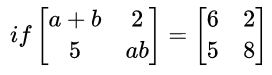
Q1    Find the value of a and b


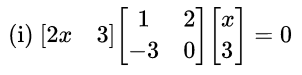
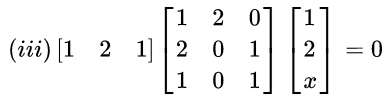
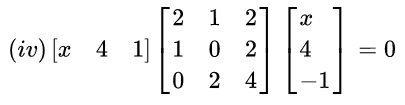
Q2 Find the value of x such that